

1. Background of Tân Hóa tourist village
Tân Hóa village, located in Minh Hóa district, Quảng Bình province, is often referred to as the ‘flood basin’ of Central Vietnam, especially after October 2010 when a historic flood with 12 meters of water submerged every rooftop here. Every rainy season, water from the surrounding limestone mountains quickly rushes into the valley, causing floods and prolonged inundation.
Every rainy season, water from the surrounding limestone mountains quickly rushes into the valley, causing floods and prolonged inundation. Traditional stilt houses can no longer withstand such extreme floods. Previously, there was a type of floating house, from ancient times Tân Hóa people liked to apply the method of building wooden rafts with banana trees, they lived on them during high flood days.
To help local people adapt, in 2014, the Living Fund (formerly the Flood-Resistant House Project) introduced the floating house model, providing a safe and sustainable solution to “live with floods” instead of fleeing.

2. Texture and materials of this house model
What are the characteristics of this model used in the area?
Areas with rising floodwaters, submerged floods (ie water rises gradually without flash floods), high water levels (4m or more).
What materials are used in the floating house model to ensure the requirements of durability, lightness, and the ability to float safely when the flood rises?
Wooden house frame (like a boat…), corrugated iron roof, mixed wood or corrugated iron walls to ensure maximum load reduction to help the house float safely.
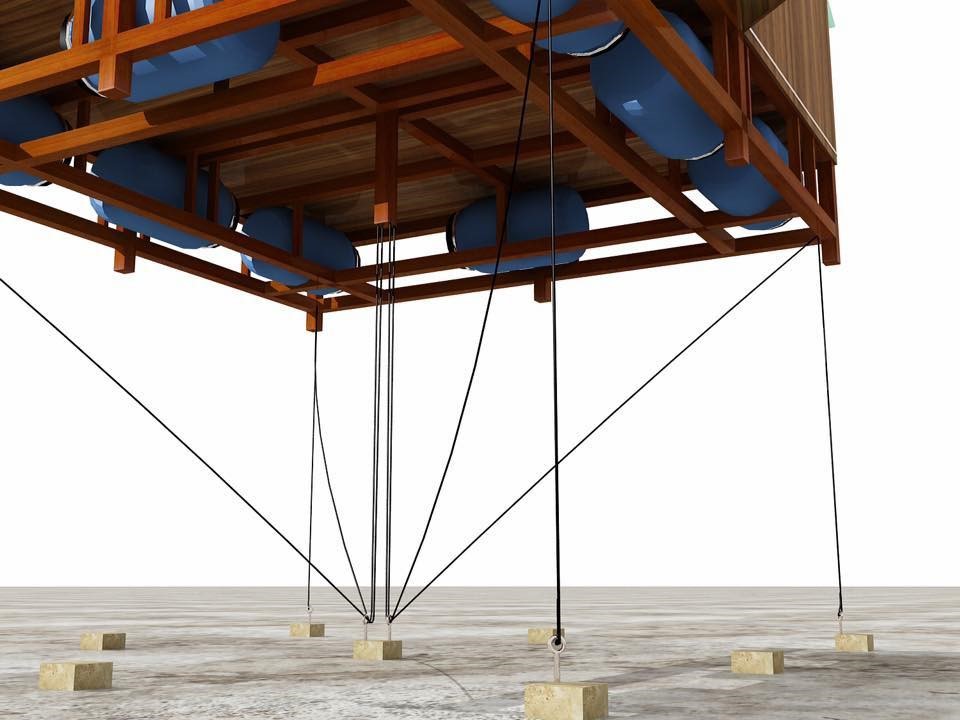
Wooden floor, attached to a plastic or iron drum underneath (plastic is a better material).
Is the lifespan of a plastic drum (when used in sunlight) guaranteed? What other features of the external drum used for floating?
Standard plastic drums are very durable even when used outdoors. During other times when there are no floods, people will remove the drum from the house and store it inside.
Drums also have another function of storing water or agricultural products for people during the time when there is no flood. This increases the usability and when stored safely, the life of the barrel will increase.
What are the equipment for safely disassembling and assembling drums?
The barrel compartment is designed with a door to push the barrel in and just anchor the door to fix the barrels in the compartment.
How many barrels are suitable for a house?
Each different house area will have a different number of barrels. Currently, in the locality, there are 3 layouts including 6 barrels, 12 barrels and 16 barrels.
The house area depends on the financial capacity of the household and their needs.
3. Ability to cope with natural disasters of this floating-house
The solution is not suitable for areas prone to landslides and subsidence?
The area where the solution is expected to be applied (Tân Hóa commune) has not seen any subsidence or landslides. According to the assessment of geological experts, the possibility of this happening is extremely low (limestone valley area, no deep abysses or natural cracks nearby). In addition, according to the report of the commune People’s Committee, in the past 5 years, no house has been washed away due to loose anchors due to subsidence.
How to fix the house vertically? When the flood comes, the house only floats up and does not float away? When the flood is high and the flow is strong, will the house be able to stay in one position?
Currently, the locality is using 2 anchoring methods: 1 is to bury 2 concrete/wooden pillars close to the house body; 2 is to bury 4 legs to anchor 4 points connecting the rope from the anchor to the house.
The project is researching the third anchoring method: a 5-point anchoring system with 4 fixed anchor points and 1 anchoring line guide point so that the house can float up and down in a near-vertical direction. The 5-point anchoring system has the characteristic that no matter which direction the water flows or the wind blows, it can stay at the anchor point. And we are continuing to research other anchoring methods to make them simple and effective.
The solution of adding more buoys and tube buoys around the edge of the house frame to increase the Archimedes’ thrust to help the house float better is also being considered.
The model’s storm resistance?
The house’s storm resistance is divided into 2 factors:
- The durability of the shelter system (roof, wall) against the wind: The option of corrugated iron and wooden walls using specialized braces to minimize the destructive force of the wind.
- The ability to resist overturning and drifting of the whole building: The house frame system is designed with a square floor, minimum height and maximum width (calculated according to budget) to reduce the impact of the wind. The 5-point anchor system enhances resistance to gusts and whirlwinds. The anchor legs are designed as buried concrete pillars that serve as both anchor points and supports when there is no flood.
4. Real-life impact and community benefits
By 2017, around 90 floating houses had been built with support from the project, and today the number has grown to over 400 units in Tân Hóa. During major floods, such as the one in September 2024, these homes allowed residents to stay safe and protect their belongings even as water levels rose dramatically.
Beyond safety, the floating houses have brought new opportunities for eco-tourism. Visitors can now explore Tân Hóa Tourist Village, meet local families, and learn how the community turns challenges into opportunities. Some floating houses are even open for homestay experiences, offering travelers a chance of experience life in the middle of nature.

5. Broader vision for sustainability
The success of Tân Hóa’s floating houses highlights the power of community collaboration — involving local residents, architects, and social organizations. This model has inspired similar projects across flood-prone areas of Central Vietnam, including Hà Tĩnh.
It also aligns with the region’s growing emphasis on green tourism and climate-resilient architecture, helping to preserve both livelihoods and local culture.
CONCLUSION
Every rainy season used to mean fear in Tân Hóa. Today, those same rains carry a different story — one of resilience and hope. The floating houses glide gently on the water, keeping families safe and life steady. It’s a reminder that even in the harshest conditions, people here have found a way to float above every challenge.
Comments